Upper Left Coast

Thoughts on politics, faith, sports and other random topics from a red state sympathizer in indigo-blue Portland, Oregon.

Wednesday, August 26, 2009

Selective auditing

So the audits division of the secretary of state has found that Oregon overspends on its cell phone costs by nearly half a million dollars every year.

State government is wasting money? Ho hum. Tell us something new.

However, there were a few things that caught my eye, things which should tell us that the half-million number is way low:
  1. While the audit included all state cell phone use, it only dug into three departments -- Human Services, Transportation, and Corrections -- and revealed that the overspending was largely due to "insufficient agency oversight." Since those departments accounted for less than 40 percent of the state's cell phone use, what kinds of abuses might have been found with deeper digging into the other 60 percent?
  2. The audit included usage from two carriers, Sprint/Nextel and AT&T; a third carrier, Verizon, did not provide usage info, and state agencies are free to use other carriers (such as T-Mobile). Who knows how much more waste would have been revealed with the info from other carriers?
  3. The audit revealed that the state paid for roughly 8,145 cell phones at a cost of $3.1 million, but again, that was without Verizon's info. How many more cell phones are covered by Verizon, and at what cost?
But the biggest surprise may have come from Audit Director Gary Blackmer, who was quoted by Oregon Public Broadcasting as saying:
We don’t in any way want to question the need for cell phones. It’s more just how we can get the best value out of them.
Say what? Why don't we want to question the need for cell phones? When the audit report includes info like this:
At DHS, one phone had more than $2,300 in charges in one year, with one month’s charges over $1,200. We found that the listed user had left state employment in April 2005. DHS staff could not tell us whether the individual or individuals responsible for these charges were employed by DHS.
why in the world wouldn't we question the need for cell phones? Do we really think that the culture that created these problems will somehow miraculously clean itself up? Never mind, don't answer that.

And remember, this is the culture that thinks the government can make the best, most cost-effective decisions about our health care.

Labels: , ,

|

Thursday, March 13, 2008

Take $3,600 out of your pay and kiss it goodbye

That's how much residents of Washington County in Oregon would lose four years from now under the U.S. House budget resolution, according to an analysis by the Heritage Foundation released Tuesday.

The analysis factors in spending increases in the budget resolution, as well as the expiration of the 2001 and 2003 tax cuts (it factors in those expirations based on best-guess scenarios of how House Democrats will pay for their spending increases under their own PAYGO rules).

Those combined factors meant that four years from now, everyone in Oregon's First Congressional District would see an average annual tax increase of $2,107, and a $1,480 income decrease. That's the steepest impact in the state of Oregon (though below the national average of roughly $3,800 per person). House District 5 is close behind at $3,525 per person, while the remaining districts are all in the $3,200 range.

So if David Wu is your U.S. representative, and if the House budget resolution becomes law, your paycheck in 2012 will be $300 lighter every month. Think you'll get enough raises between now and then to keep your wages at 2008 levels? Me either.

Oh, and by the way, it also projects 12,000 lost jobs statewide, and a $1.2 billion hit on the state economy. Won't that be fun for state budgets?

But that's nothing compared to our neighbors across the Columbia. Residents of Washington House District 3 would say sayonara to almost $4,100 every year (and those poor suckers in Washington House District 8 would lose another $1,000 on top of that), and the state as a whole will lose 21,000 jobs and take a $2.4 billion economic hit.

But hey, the Democrats are looking out for the little guy.

Labels: , , ,

|

Friday, November 16, 2007

Quote of the Day: on Oregon tax reform

Today's quote of the day comes from Rob Kremer, who noted a new task force to study ideas for restructuring state revenue sources. The task force has two spots for "taxpayer association representatives," and one of the spots went to Chuck Sheketov of the Oregon Center for Public Policy (OCPP). This prompted Rob to proclaim:
Calling the OCPP a taxpayer association representative is roughly the equivalent of calling Planned Parenthood an "Embryo Advocacy Organization."

Labels: , ,

|

Monday, July 23, 2007

The source of that Oregon campaign money

The people who want to be our next president reported a couple of weeks ago on their campaign hauls through June 30, and the surprise winner in Oregon (surprising to me, at least) was Republican Mitt Romney, who pulled in nearly a third of a million dollars from the Beaver state.

The most surprising thing, however, was not just that Romney pulled in the most money; the real surprise was that he had 56 percent more than runner-up John Edwards, and almost as much as Edwards and Hillary Clinton combined ($326,610 for Romney vs. $208,447 for Edwards and $126,888 for Clinton). Also surprising was the fact that the Republicans, despite being out-raised nationwide by 50 percent, slightly out-did the Democrats in Oregon.

So that got me wondering where Romney's Oregon money is coming from. And just for good measure, I looked at Edwards' money as well.

(I should note that, while I got all this information from the cool New York Times database, my numbers may be slightly different than those of the Times because of errors I found in the Times' database. For instance, the Times listed some California donors under an Oregon Zip code. Also, when I refer to a "donor," that could mean multiple donations from the same person. If Joe Smith made five different donations of $100 each, I would count that as one donor contributing $500.)

One of the first things I found interesting was that Romney pulled in more money from Multnomah County than did Edwards -- almost 20 percent more. Of course, the Democrats as a whole did what you'd expect in Multnomah County: they raised 36 percent more for their candidates than did the Republicans. Still, considering Multnomah County is home to 2.4 registered Democrats for every registered Republican, this remains notable.

Another interesting -- though predictable -- aspect was the source of the money. Virtually all of Edwards' money came from west of the Cascades, while Romney's cash was more scattered around the state.

Also, if you look at the percentage of the haul that came from each county, and compare that to each county's percentage of the state population, very few counties donated proportionately. For Edwards, only Multnomah, Clackamas and Clatsop counties gave more than their population percentage. For Romney, Multnomah, Clackamas, Washington, Deschutes and Umatilla exceeded their populations. (It would be interesting to do some sort of comparison to per capita income, but -- truth be told -- I've already put in too much effort on this project.)

One of the things that became glaringly obvious was the number of big donors in each camp. As should be obvious by comparing the number of donors to the total haul, the typical Edwards donor was making smaller contributions than the typical Romney donor.

There are certainly plenty of examples of large donations to the Edwards camp -- among them:
  • $7,400 from David & Christine Vernier of Portland;
  • $4,600 from Mark and Sheri Bocci of Lake Oswego;
  • $3,100 from State Rep. Mitch Greenlick and his wife Harriet.
  • $2,800 from Terri Naito, a policy advisor to Multnomah County Commissioner Lisa Naito;
  • $2,300 from Columbia Sportswear's Peter Bragdon, the former chief of staff to Gov. Ted Kulongoski;
  • $2,300 from Portland developer Homer Williams;
  • $1,656 from Mandate Media's Kari Chisholm (or, as the Times' database calls it, "Madnate Media"); and,
  • $1,000 from Lynn Lundquist, the former Republican (!) Speaker of the Oregon House of Representatives.
But a typical example is Lorre Lewis of North Bend, who made three separate donations of $20 each, plus another for $19.53. Or Priscilla Oien of Tualatin, who made 10 separate donations of $100 each.

Romney, meanwhile, was supported by a variety of business, legal and investment heavyweights, including:
  • Rod Wendt of Jeld-Wen, who combined with his wife to give $4,600;
  • Kevin Mannix, who gave the same amount with his wife;
  • Peter & Julie Stott of Crown Pacific, $4,600;
  • Tim & Mary Boyle of Columbia Sportswear, $4,600;
  • Frederick & Gail Jubitz, $4,600
  • Ron Saxton of Ater Wynne, who gave $2,100 (his wife Lynne gave another $500 through the Christie School);
  • H. Gerald Bidwell, $2,000; and,
  • Richard Reiten, the retired Northwest Natural exec, $1,500.
I know it takes money to run a campaign, but I think this feeds into an achilles heel of the Republicans: the perception that the GOP is controlled by big-money interests. Should Fred Thompson decide to get into the race, however, I think you'll find that many of his supporters will be more similar to the $80 Edwards supporter I mentioned above.

Labels: , , ,

|

Tuesday, April 10, 2007

World ends, higher education hit hardest

As a University of Oregon alum, I received an "important message" from University President Dave Frohnmayer yesterday (emphasis in original):
We are at a critical time in the budget negotiations in Salem, and I need your help to protect our state funding. In December, Governor Ted Kulongoski proposed a budget for higher education that would provide stability and begin to undo a decade of disinvestment. However, the budget recently proposed by the co-chairs of the Ways and Means Committee takes a significant step backwards from the governor's request. Simply put, this proposal, if enacted, would degrade the quality of the University of Oregon.
It would degrade the quality of the school? Wow, it must be bad. You'd think Republicans were in charge of the budget, but no -- the Ways & Means co-chairs are Sen. Kurt Schrader of Canby and Rep. Mary Nolan of Portland, both Democrats.

The email continues:
The co-chairs have cut $35 million from the Oregon University System operating budget. This includes cuts to enrollment growth and faculty salaries. If enacted, the cuts would mean higher tuition for Oregonians. The co-chairs also cut 83 percent from the Oregon University System capital construction budget.
Thirty-five million? What are they thinking? Did Karl Rove plant mind probes into their brains?

It concludes by asking me to contact the committee members to express my concern "about the proposed cuts to higher education - concern that is being conveyed almost daily in newspaper editorials across the state."

Oh, newspapers are editorializing against it? Double wow. It must be really bad.

But wait.

At Rogue Pundit, we get a clearer picture of what's really going on. RP wrote last week that the current higher ed budget is $735 million, which was actually about $6 million less than the 1999-2001 figure. Clearly, the higher ed budget has slipped over the last eight years, so for 2007-2009, Gov. Kulongoski proposed a new budget figure of $859 million, an increase of almost 17 percent.

The Ways & Means co-chairs reduced Kulongoski's proposal to $843 million, so it's only an increase of nearly 15 percent. So what President Frohnmayer calls a "cut" is really just a smaller increase, and what he claims will "degrade the quality of the University of Oregon" is really a lie.

Yes, that's right. A lie. It might not be the increase Mr. Frohnmayer wanted. It might not even be the increase that's justified. But an additional $108 million dollars will not degrade the university system or the U of O, and I believe Mr. Frohnmayer knows it. And his threat of higher tuition is a reprehensible, unjustified threat.

(The governor's recommendation of $483 million for community colleges was reduced to $458 million; and his $401 million budget for university construction bonds was reduced to $56 million, because the Ways & Means co-chairs were concerned about the level of the state's already-existing debt load. But those figures do not "degrade" the university, either.)

Rogue Pundit makes another interesting observation: inflation over the last eight years has increased by 23.2 percent, so even a 17 percent increase falls behind inflation. It would have to be $914 million to match inflation.

But meanwhile, the K-12 budget, which was $4.6 billion in '99-01, is scheduled to increase to $6.245 billion in '07-09, an increase of almost 36 percent.

If we were concerned with keeping up with inflation, that figure would only be $5.67 billion, or a difference of almost six hundred million dollars. If we kept the K-12 budget at the rate of inflation, we could bring the university system up to the inflation level and still have half a billion dollars to fill a rainy-day fund without increasing taxes on corporations.

If we wanted.

Labels: , ,

|

Tuesday, April 03, 2007

This will accomplish...what?

While I was away for Spring Break, I see the junior senator from the state of Oregon completely imploded. Gordon Smith voted in favor of a troop pullout within four months, distinguishing himself as the only Senate Republican willing to tell al-Queda how long it had to wait before it could start a full-scale slaughter of Iraqi civilians.

With that vote, Sen. Smith lost my support in 2008. I won't vote for his Democratic opponent (whomever it may be), but I won't support Smith, either.

However, the Northwest Republican rumor mill reported that Bill Sizemore may be considering a primary election challenge against Sen. Smith next Spring.

You remember Sizemore, don't you? In the 1998 governor's election, he won exactly one county against Incumbent John Kitzhaber, and that was tiny Malheur County, where he beat Kitzhaber by 363 votes. Overall, Kitzhaber beat Sizemore by 383,000 votes out of 1.1 million total votes cast, or more than 34 percentage points.

The author of a plethora of tax- and union-related ballot measures, Sizemore has been the favorite whipping boy for the unions. That included a multi-million-dollar racketeering judgment against him that took almost seven years for him to clear his name in the courts.

Sizemore is, in some respects, the Oregon version of Newt Gingrich; good ideas that are obscured by personal foibles. (I'm not saying Sizemore has Gingrich's ability to communicate or to think of creative policy ideas, only that his efforts are blunted by his personal issues.)

Run Bill Sizemore against Gordon Smith, and what happens? Most likely, Smith will clean the floor with him, because Republicans may agree with Sizemore's priorities, but I don't think they're willing to vote for someone with his history. It will mark Sizemore's second effort to "send a message" through personal candidacy, and will mark his second devastating defeat.

The only possible impact on Gordon Smith will be that he has to spend some of his campaign money to ward off a primary challenger (though I don't see that being a lot); and he has to defend his Senate votes earlier in the campaign season, thus exposing his inconsistencies to a press and a Democratic Party that are both eager to trumpet those issues.

Although doubtful, there is another possible outcome stemming from a Sizemore-Smith matchup: perhaps Republican resentment against Smith is broader than I imagine, and Sizemore squeaks past Smith in the primary. What happens then? Sizemore gets pasted by the Democratic machine even worse than in 1998, and becomes even more of a laughing stock.

It will also be a knock-down blow for Oregon's Republican Party, which will once again demonstrate its lack of effective candidates and organization and will cause independents to lose faith in the party's legitimacy.

Gordon Smith, for all his maverick status, is still a more reliable conservative vote than any Democrat (including Joe Lieberman) will ever be, and in many respects I hope he wins reelection in '08. But regardless, a Bill Sizemore candidacy would be a disaster -- for him, for his priorities, and for his party.

Labels: , , ,

|

Tuesday, March 06, 2007

Quote of the Day: Raising Oregon Taxes

For the last several days, the Oregonian has been singing the praises of Oregon Republicans for finding a compromise that eliminates the corporate kicker and increases corporate taxes in order to create a rainy-day fund.

In Sunday's print edition, resident conservative David Reinhard framed it as a Republican victory (I can't find it on the paper's website), under the headline, "Why Scott and his House GOP are smiling."

But.

In this morning's Oregonian, we learn that all is not hunky-dory in either the Oregon business community or the Republican caucus. Once the details were examined, it turned out that the tax structure could mean identical businesses, one of which earns a dollar more in income than the other, could be paying a difference of tens of thousands of dollars in taxes. And suddenly, the supposed groundswell of support from the Oregon business community is unraveling, as small business owners -- you know, the ones who provide the vast majority of jobs in Oregon? -- protest a huge government-sponsored grab at their livelihood.

But never mind that. They're just whiners. A spokesman for House Minority Leader Wayne Scott said "there are no second thoughts" in the Republican caucus. The story by Betsy Hammond added:
Democrats acknowledged imperfections in the plan but said lawmakers in both parties need to honor the deal brokered by their leaders. Getting a rainy day fund for Oregon and raising its archaic $10 minimum corporate tax are too important, they said.
In other words: we know it stinks, but we do what our leadership tells us to do. The possibility of putting you small business owners out of business or creating layoffs is so far down on the list of concerns that it doesn't register. We want the good press from the Oregonian telling us how great we are.

In fairness, the story does say that House Majority Leader Dave Hunt and others "are willing to modify the new corporate minimum tax rates after the package clears both the House and Senate." Call me a skeptic, but I'll believe it when I see it. Once the package is approved by both chambers, there is little reason to believe the Democrat-controlled legislature won't simply send it on to the governor.

As Dare!PDX noted at Northwest Republican this morning, now that Republicans are on board, suddenly the press is calling it a tax increase, something it was loath to do when Democrats were leading the charge. And Democrats are giddy with excitement over the GOP-crafted plan to raise the corporate minimum as high as $50,000 because, Hammond notes:
it would generate an additional $150 million for each two-year budget.
And that should tell you everything you need to know about the supposed victory of the GOP, about the party's commitment to low taxes, and about the Republicans' support for small businesses.

Labels: , , ,

|

Thursday, January 18, 2007

Savings to save Oregon's credit rating

According to the state director of debt management, Oregon has one of the three worst state credit ratings in the country -- only ahead of California (land of multi-billion-dollar deficits) and Louisiana (which has been shelling out cash for a little storm called Katrina).

What's the cause for this low rating? The lack of a state savings account, the debt managers told state budget writers on Wednesday. All we have to do is sock away more in a rainy-day fund, and we're on our way to happy days in the eyes of our creditors.

But wait, I thought to myself. When a family gets into financial trouble and its credit rating drops, it's usually because that family is maxing out its credit, paying late or not at all, and losing assets through repossession, foreclosure, legal judgments and/or bankruptcy.

In other words, the family is spending too much.

Sure, a well-stocked savings account would be helpful, but that's not the cause of its credit troubles, only one symptom of the challenges that have contributed to the financial slide.

I realize that it's difficult to compare a family and a state, considering the latter (usually) can't descend into deficit spending. But could it be that the state's credit worthiness is based on a decade of drunken-sailor spending when it had the cash to create a rainy-day fund? Could it be that the credit rating firms are looking for all-around financial responsibility from Oregon, which includes fiscal restraint?

And what do we have instead? The Oregonian's political blog spells it out:
In his budget proposal, Gov. Ted Kulongoski proposed spending all but $145 million of the nearly $15 billion projected to be available for the state to spend in 2007-09, plus raising more taxes and spending them too. He would fatten the state savings account by canceling all $275 million of corporate "kicker" tax rebates and putting the money into savings instead. Doing so would require a two-thirds vote of the House and the Senate, a daunting hurdle.
In other words: spending every penny of tax revenue, increasing taxes, and hoping that 20 senators and 40 representatives will go along with killing the corporate kicker to put that money in savings -- because those corporations (especially the out-of-state companies) need to hire our residents and send their taxes to Salem, but otherwise should shut up.

Don't get me wrong -- I think a savings account is important (for a family, a business, or a government) and I hope the state implements a rainy-day fund in this session.

But maybe, if Ted Kulongoski and the Oregon legislature weren't hell-bent on spending every penny of revenue (and then some), maybe they'd have plenty of money for savings. And I bet the credit rating firms would be just as impressed by spending restraint as by a rainy-day fund.

Labels: , , , ,

|

Friday, January 05, 2007

Quote of the Day: on Oregon education

Rob Kremer writes today about the big three ideas floating around the education community in Oregon -- all-day kindergarten, Head Start, and decreased class sizes.

Kremer, who is the director of the Arthur Academies and an advocate for charter schools, says he would sooner focus on "effective teaching practices" at the elementary level than spend money on any of those three. Why? Because the research shows that none are terribly effective:
  1. All-day Kindergarten becomes nothing more than additional playtime for the kids and additional babysitting for the parents, because Kindergartners can't handle a full day of academics;
  2. Decreased class sizes are only effective when the size drops to at least 15 kids, and no one ever mentions that smaller classes means more teachers and more classrooms and, thus, more money that needs to be spent; and
  3. The gains made in Head Start disappear by third grade.
So, if we have to choose one, what's the best choice? Kremer answers:
...I'd say that the Head Start is the best option. At least it's targeted to the kids who are most in need - and most likely to fail. And it has the added benefit of keeping the dollars out of the education establishment and the teachers union!

This, of course, is the reason why the Head Start option will probably lose. The unions will get their way, and from their perspective, they like both lower class sizes AND all day kindergarten, because they both result in more dues paying members.
One other thing: in Kremer's analysis of full-day Kindergarten, he said that the Arthur Academies do have academic kindergartens that focus on phonics and basic math, but any change in the state's Kindergarten structure wouldn't change the AA focus. He adds:
Oh, by the way, our kindergartners are off-the-charts in academic achievement, which calls the question: if we can do that in a half day, why would a full day be required?
Why indeed?

Labels: , ,

|

Sunday, November 12, 2006

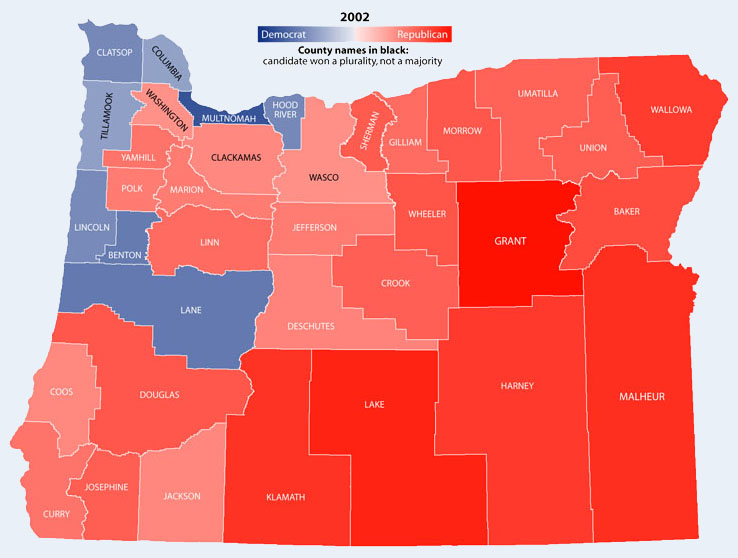
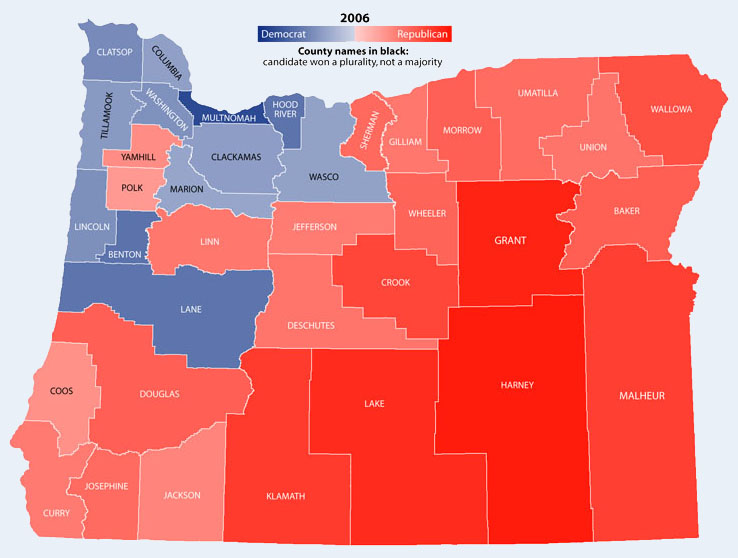
The Oregon governor's race by county

For what it's worth, here's Kevin Mannix vs. Ted Kulongoski in 2002:


and here's Ron Saxton vs. Kulongoski this year.


The darker the color, the more heavily the vote went to the winner. Thus in '06, Kulongoski won Multnomah County with 68.4 percent of the vote, while he won Marion County with 46.6 percent; Saxton won Harney County with 72.7 percent, but took Polk County with just 46.3 percent.

Labels: , , , , ,

|

Saturday, November 11, 2006

A pointless thought on Ted Kulongoski

In Tuesday's election, the governor won Tillamook County by 600 votes. In light of the governor's comments regarding the flooding, do you think there are 301 voters in Tillamook County who might regret their vote?

According to today's numbers at the Secretary of State's website, he won the state by 102,217 votes; do you think there might be 51,109 voters statewide who might think twice about voting for a man who criticized the media for over-hyping a flood that destroyed homes, shut down businesses and cost a life? Who dismissed home losses as the "price to be paid" for a view?

(On the state-wide question, probably not -- if Democrats are willing to ignore legitimate questions that the governor knew about Neil Goldschmidt's sexual escapades with a teenage girl, they're certainly not going to vote against him for dissing a homeowner picking pieces of his house out of the turf.)

By the way, the weather must have been fairly bad, because he said it was too dangerous for him to take a helicopter tour. Too bad he wasn't willing to reveal the true Ted Kulongoski until the day after the election...

Labels: , , ,

|
 
Google